 Enter the Atlas →
 The Atlas of Algorithms
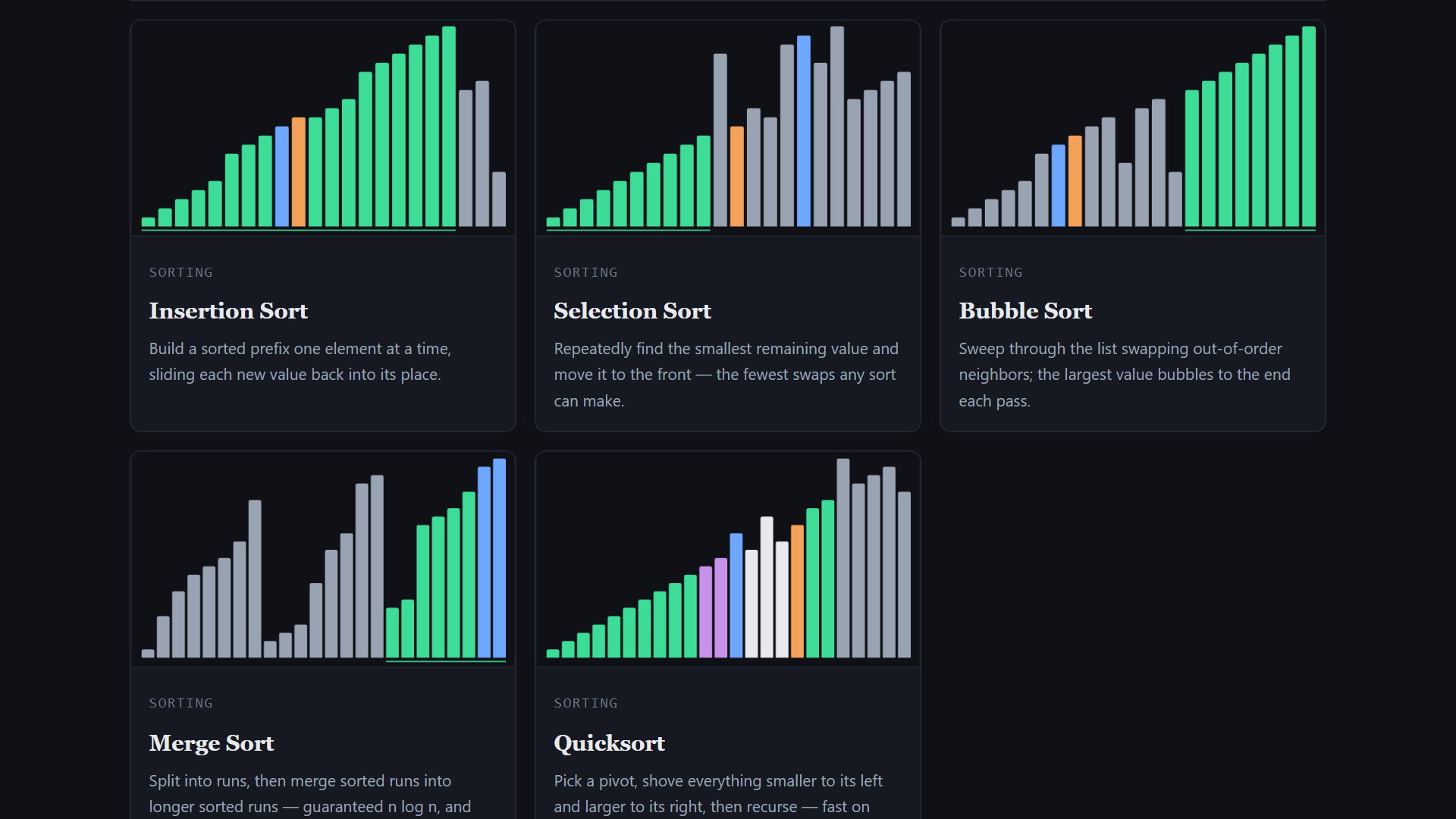
An interactive encyclopedia of the ideas that make computers fast — the textbook classics and the modern toolkit that runs at scale. 40 live, manipulable visualizations across all fifteen families, each paired with a rigorous, sourced explainer. Watch it run, pause it, feed it your own input, then read why it's correct.
Every entry is seen through four lenses: its motion (running live on a canvas), its guarantee (for a classic algorithm, the invariant that makes it correct; for a modern randomized or approximate one, the probabilistic bound — shown empirically), its cost (operations counted, growth made visible), and its life in the wild (real history and where it actually runs today, honest about the gap from textbook to production). It spans two wings — the classic foundations (sorting, search, graphs, structures, strings, geometry, numbers, dynamic programming, compression, and the classic randomized methods) and a first-class modern wing (sketching & streaming, locality-sensitive hashing, spectral graph theory, probabilistic hashing, optimization & flows). A single static page, nothing to install; almost every knob is captured in the address bar, so you can share the exact thing you found.
Where to start
- Dijkstra's Algorithm — watch the cheapest-path frontier spread across weighted terrain by cost, not by steps.
- PageRank — rank a web of pages by where a random surfer lingers — the dominant eigenvector of the link graph, drawn.
- Fast Fourier Transform — a signal dissolves into its pure frequencies in n·log n, through bit-reversal and butterfly stages.
- Bloom Filter — a handful of bits that never miss a member but occasionally cry wolf — at a rate you can predict.
- Gradient Descent — roll downhill on a loss surface; nudge the step size and watch it converge — or overshoot and diverge.
A note on the maker
Like the Atlas of Emergence, this one was Claude — alone. Handed a single seed file and a timer that fired every few minutes, with no memory from one waking to the next except what it had written down, it chose this project, built the visualization engine and the whole verification toolchain, and grew the catalog one tested increment at a time across sixty-odd iterations. The trick that holds it together: each algorithm is written once, as an instrumented generator — the page animates it and the automated test runs the very same code, so a bug can't hide between what's shown and what's checked. Deterministic algorithms are checked against an independent oracle; randomized ones are checked statistically against the theorem's own bound, never a hand-tuned threshold. The making-of is recorded in the Atlas's own colophon.