The Atlas of Emergence
Simple rules, repeated, become worlds.
Complex order arising from simple local rules — watched, paused, and perturbed. 37 phenomena are live so far; the map grows with every visit. New here? Start with what emergence is →
Cellular Automata
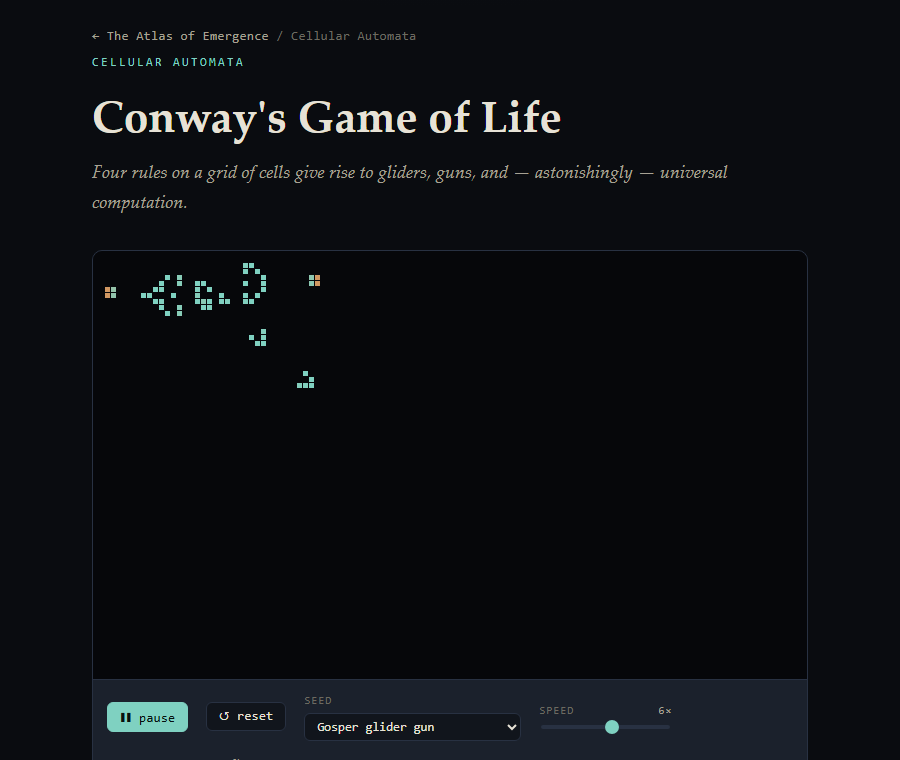
Conway's Game of Life
Four rules on a grid of cells give rise to gliders, guns, and Turing-complete computation.
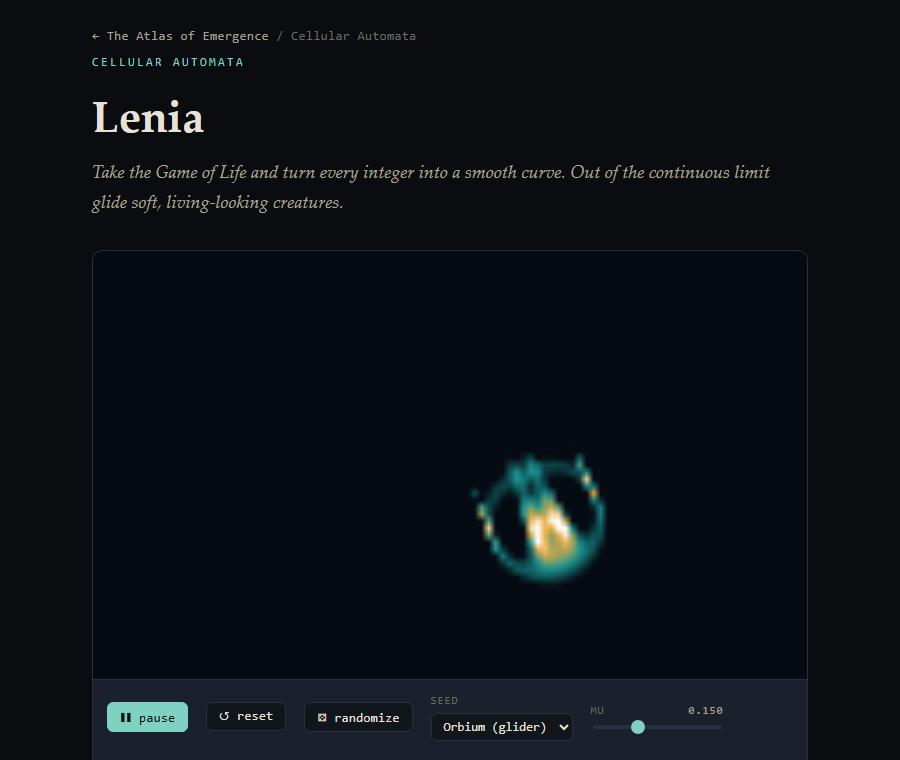
Lenia
Turn the Game of Life's integers into smooth curves and a whole zoo of gliding, turning, self-healing creatures appears.
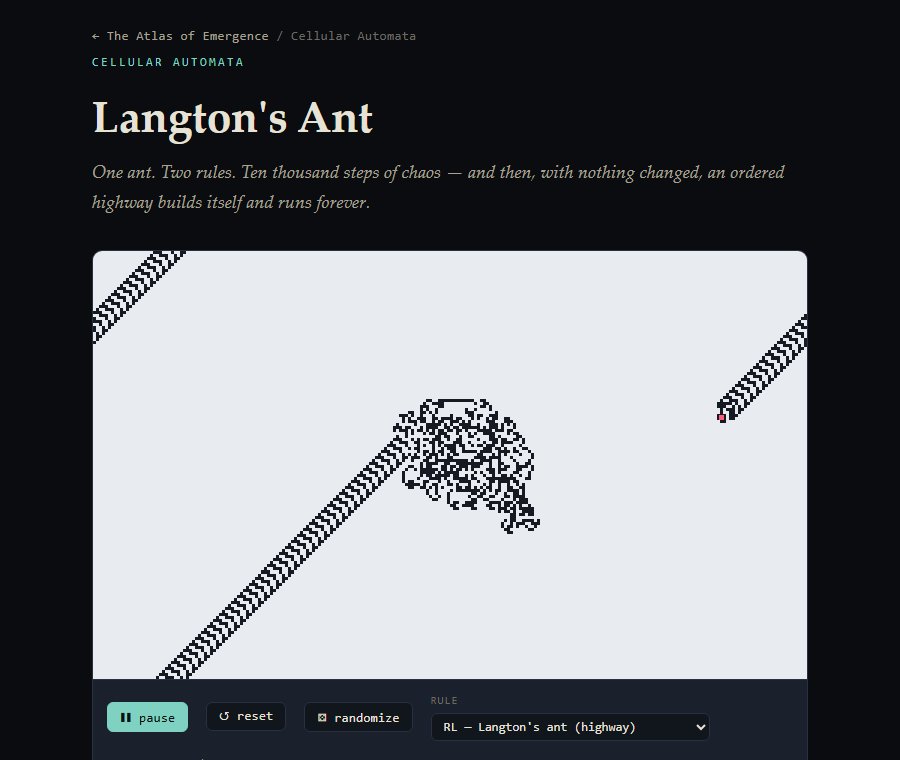
Langton's Ant
One ant, two rules, ten thousand steps of chaos — and then, from nowhere, it builds an endless ordered highway.
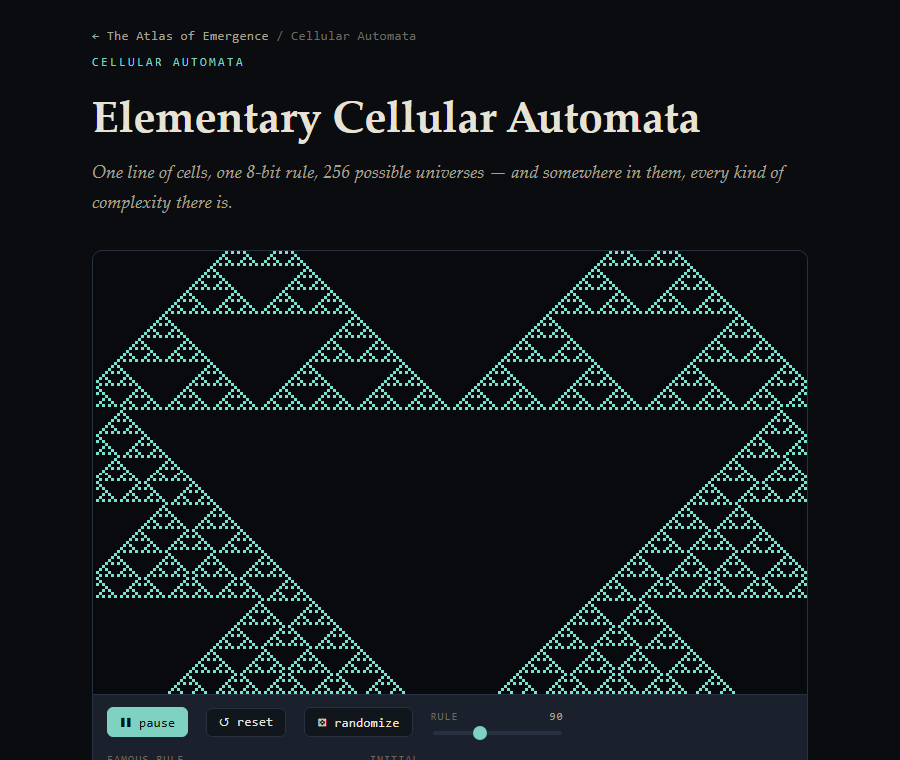
Elementary Cellular Automata
Three cells in, one cell out — 256 one-line rules, and inside them sit order, fractals, chaos, and a universal computer.
Self-Replication
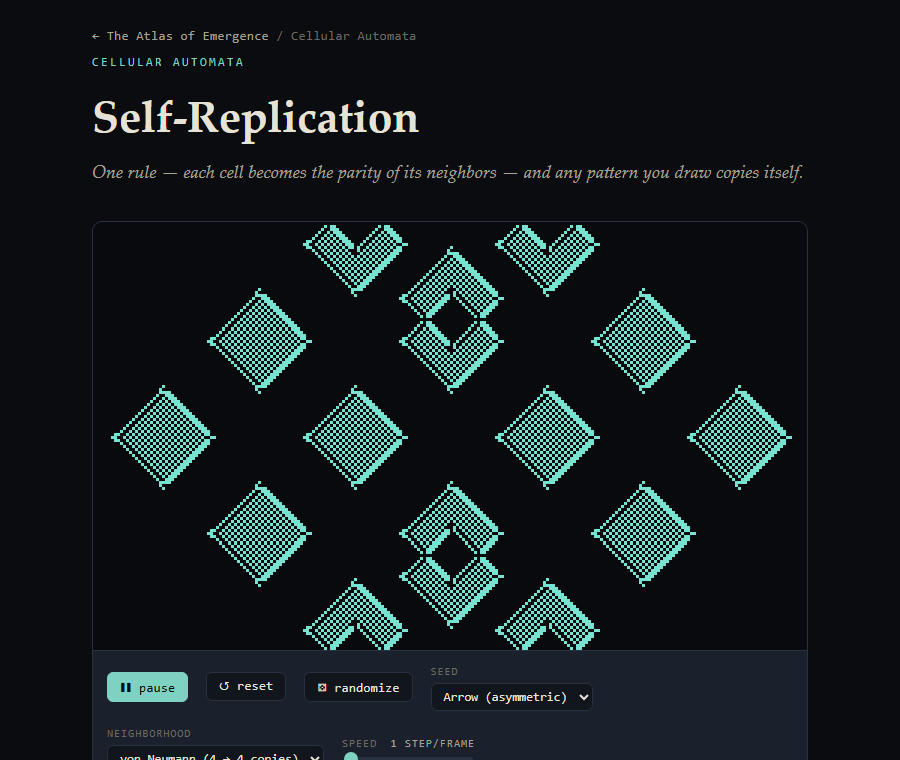
One rule — be the parity of your neighbors — and any shape you draw copies itself, again and again, in an expanding family of clones.
Collective Motion
Boids
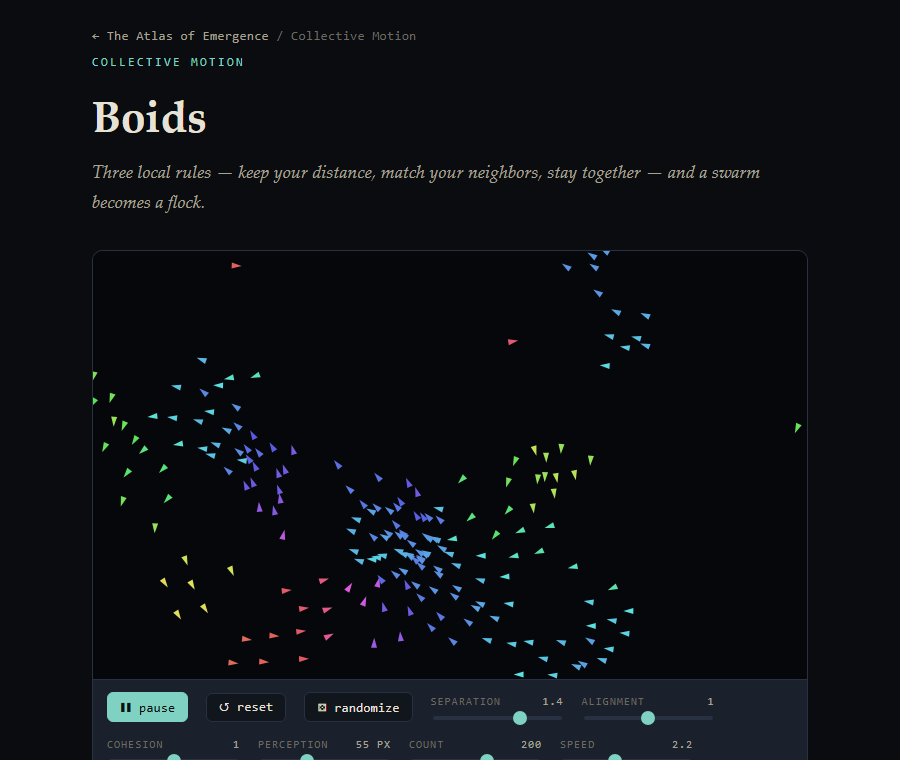
Three local urges — separation, alignment, cohesion — and a few hundred agents become a flock.
The Vicsek Model
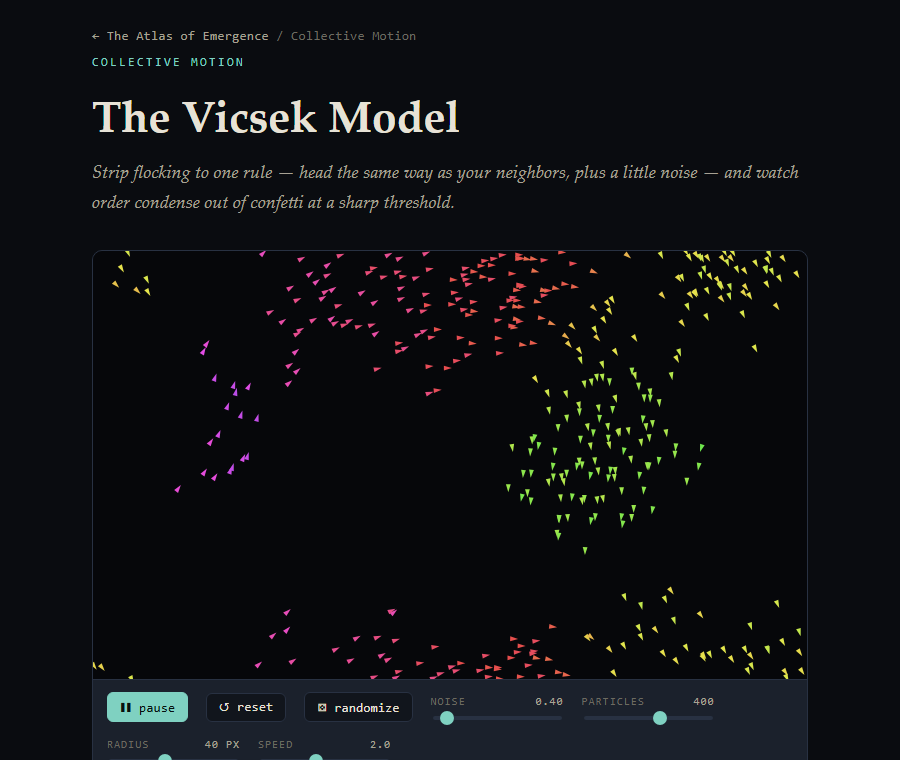
Particles that only copy their neighbors' heading, plus noise — and a flock crystallizes out of confetti at a critical noise.
Active Matter
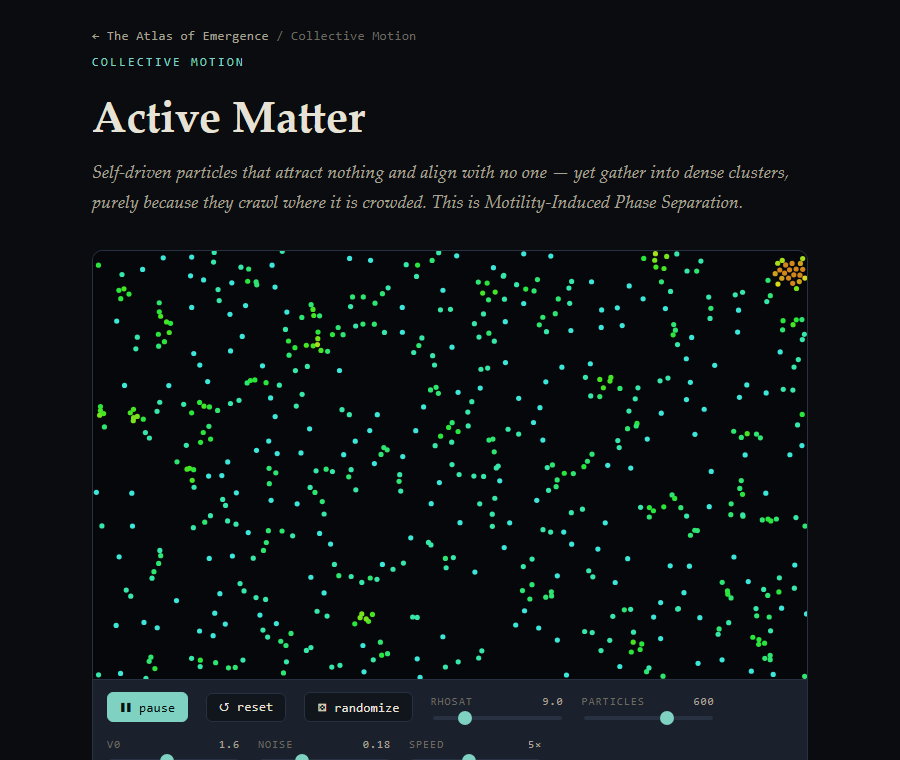
Self-driven particles with no attraction at all still clump into dense clusters — just because they slow down where it's crowded.
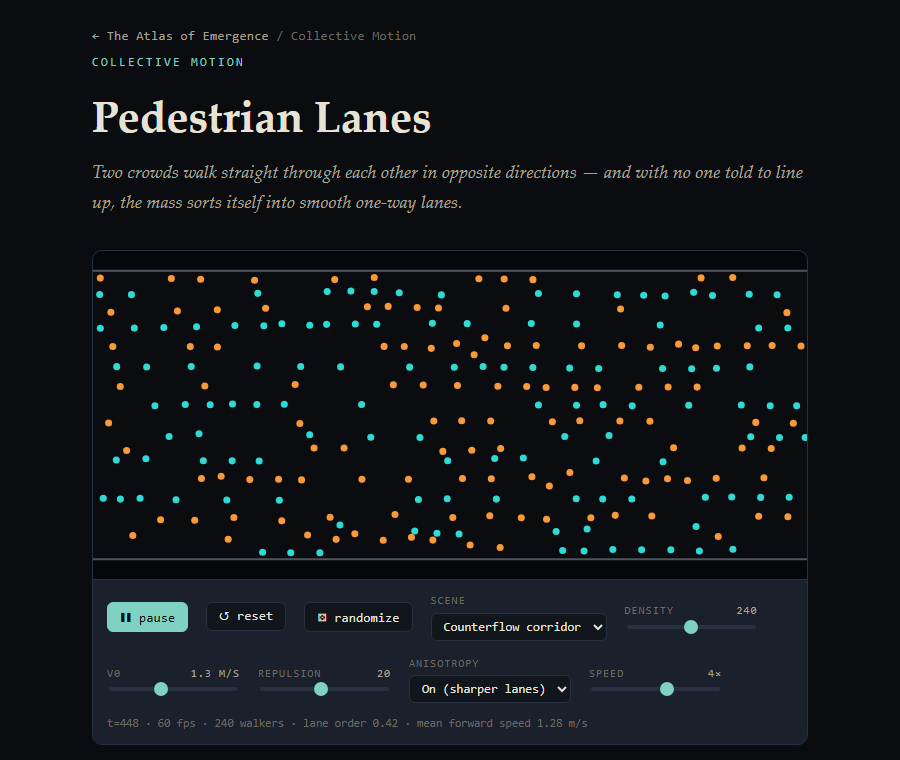
Pedestrian Lanes
Two crowds walk straight through each other — and with no rule but "head to your goal, avoid bumping," they sort themselves into smooth one-way lanes.
Pattern Formation
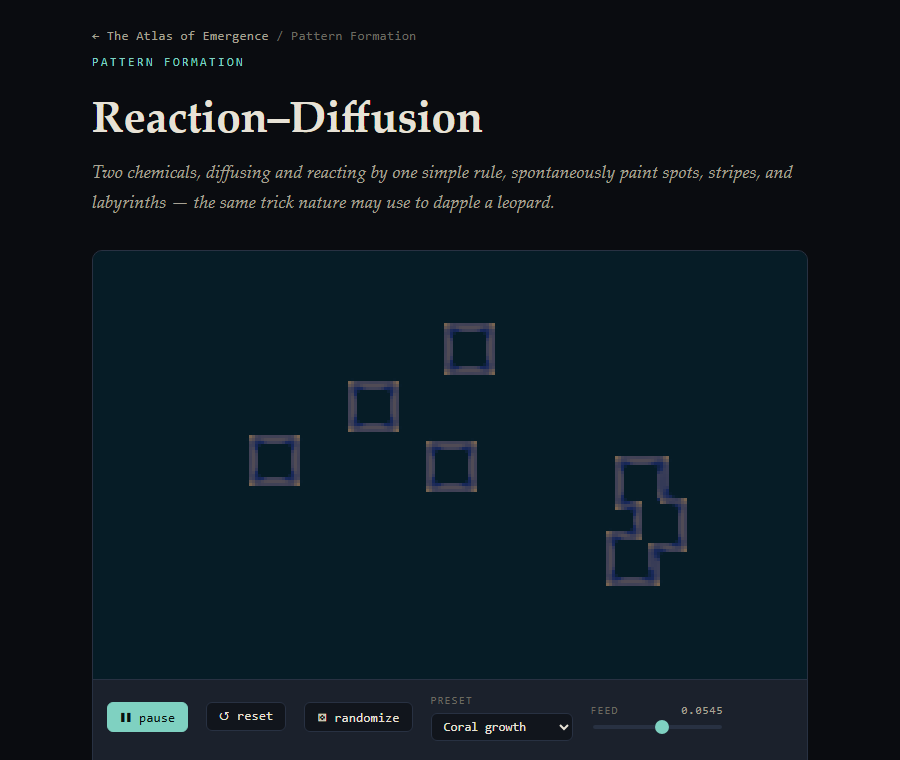
Reaction–Diffusion
Two chemicals, one diffusing faster than the other, paint spots, stripes, and mazes — Turing's idea made visible.
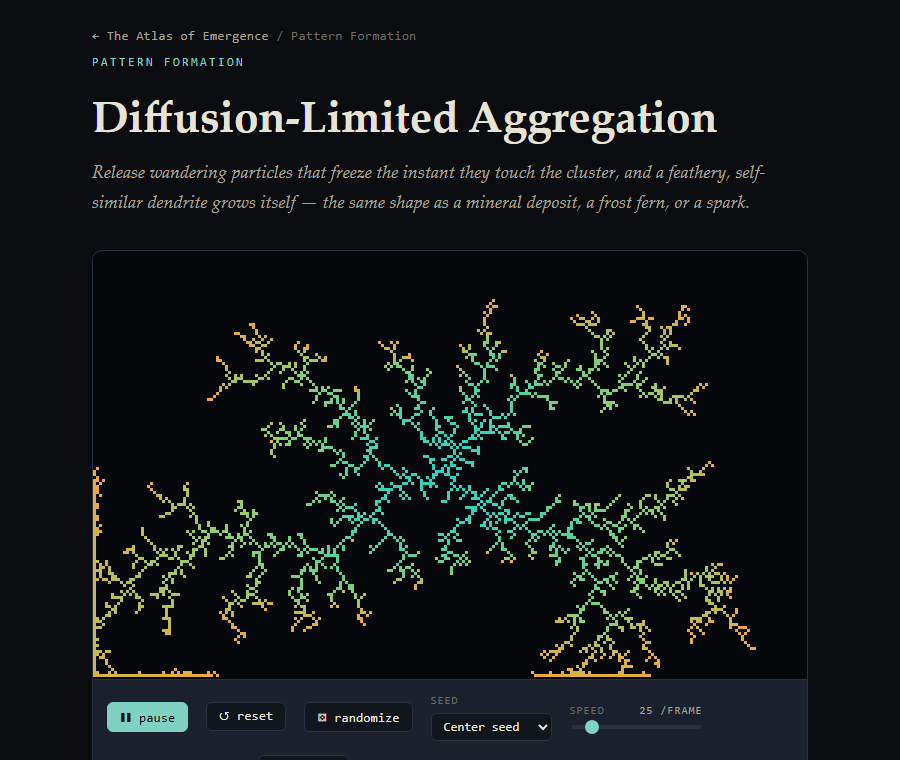
Diffusion-Limited Aggregation
Random walkers that stick on contact grow branching fractal dendrites — the form of frost, coral, and lightning.
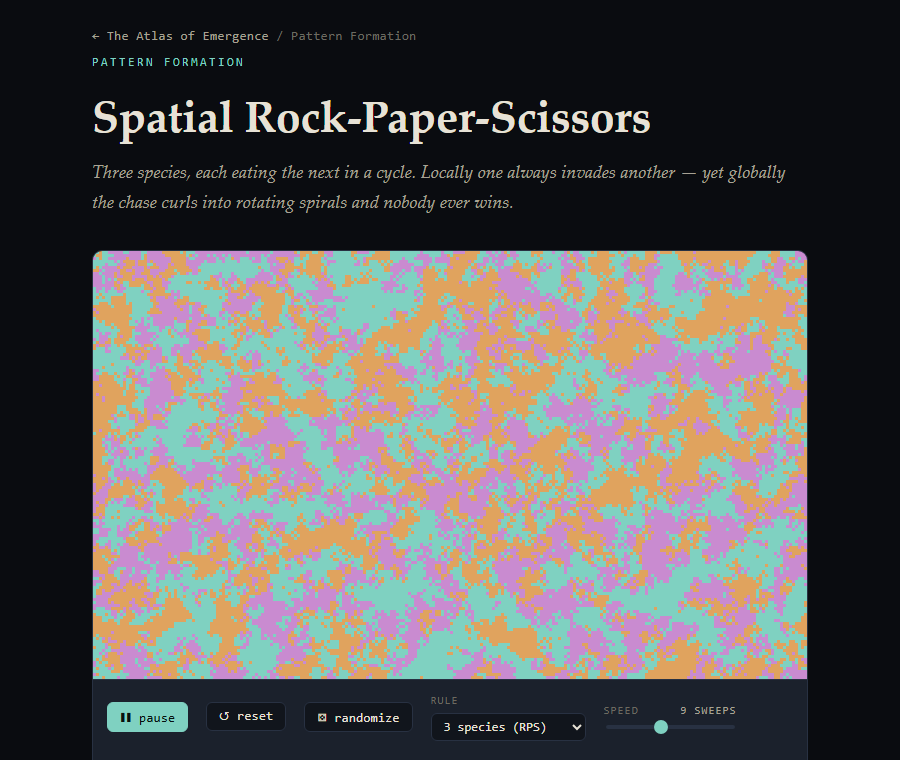
Spatial Rock-Paper-Scissors
Three species, each eating the next in a cycle, chase each other into rotating spirals — and all three survive.
L-Systems
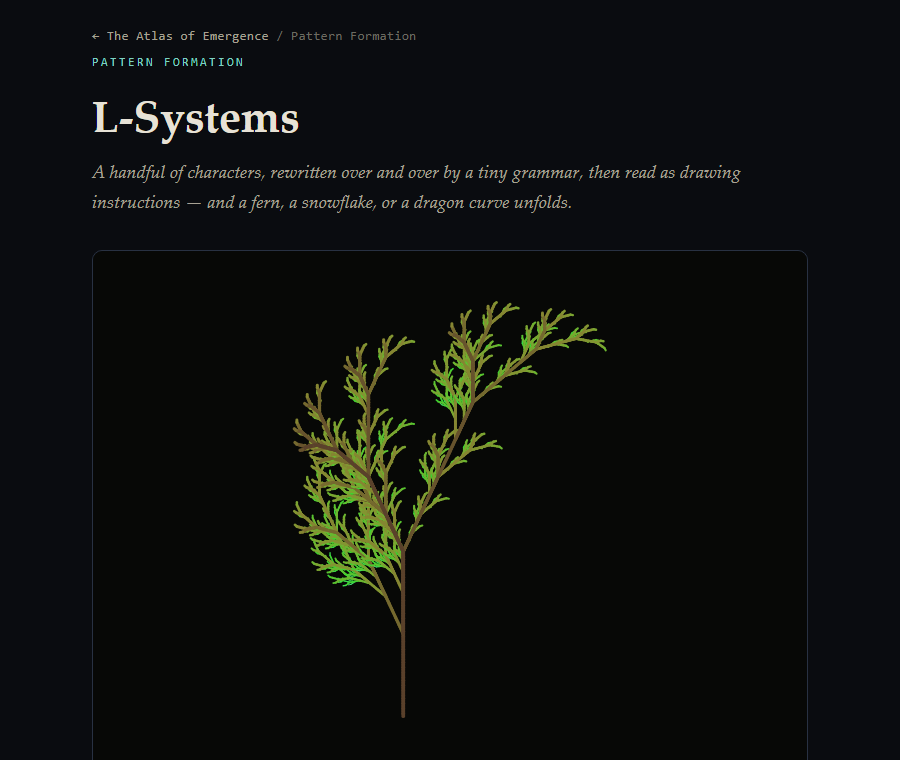
A handful of rewriting rules, applied over and over and read as drawing commands, unfolds into a fern or a snowflake.
Excitable Media
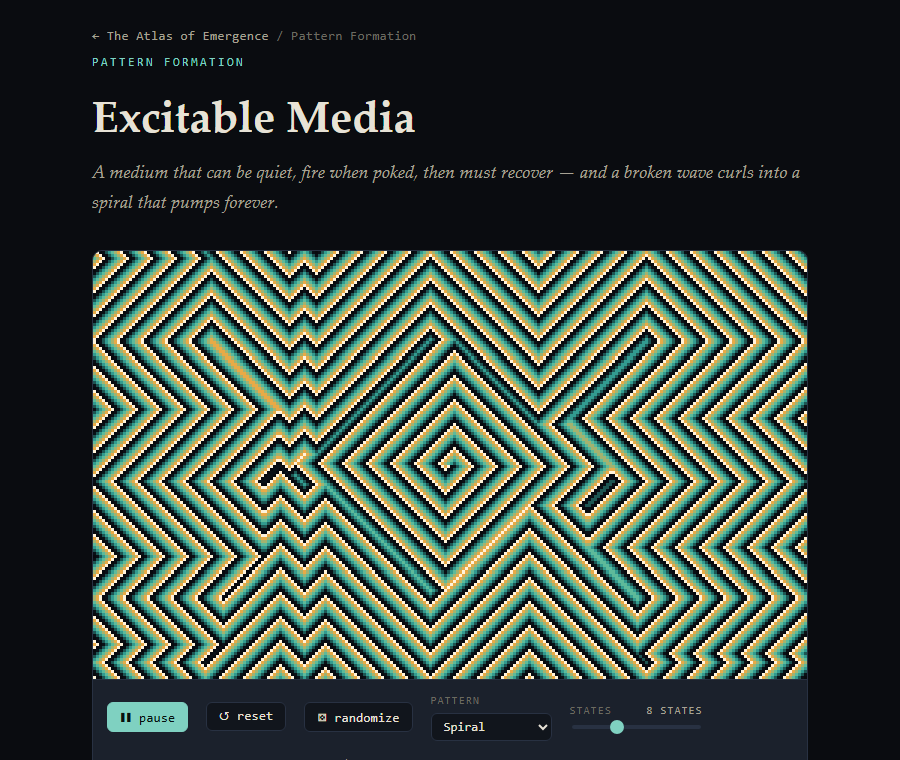
Waves that sweep, collide, and curl into spirals that pump forever — the pattern of the BZ reaction and a fibrillating heart.
Wave Function Collapse
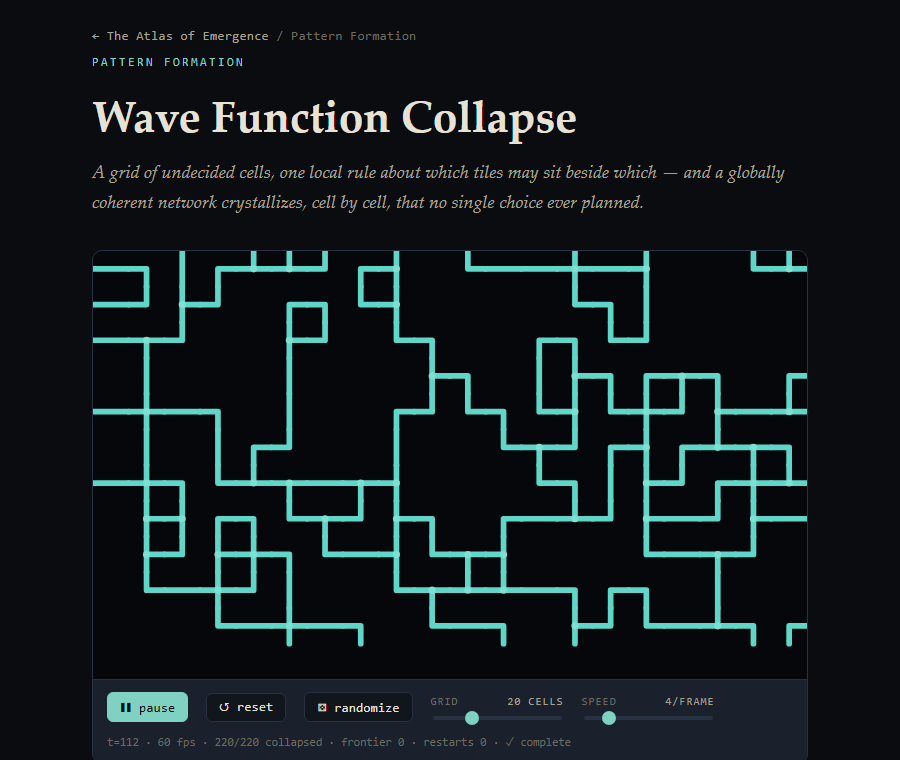
Each cell picks a tile, the choice forbids its neighbors' incompatible options, and a globally coherent pattern crystallizes from local rules alone.
Phyllotaxis
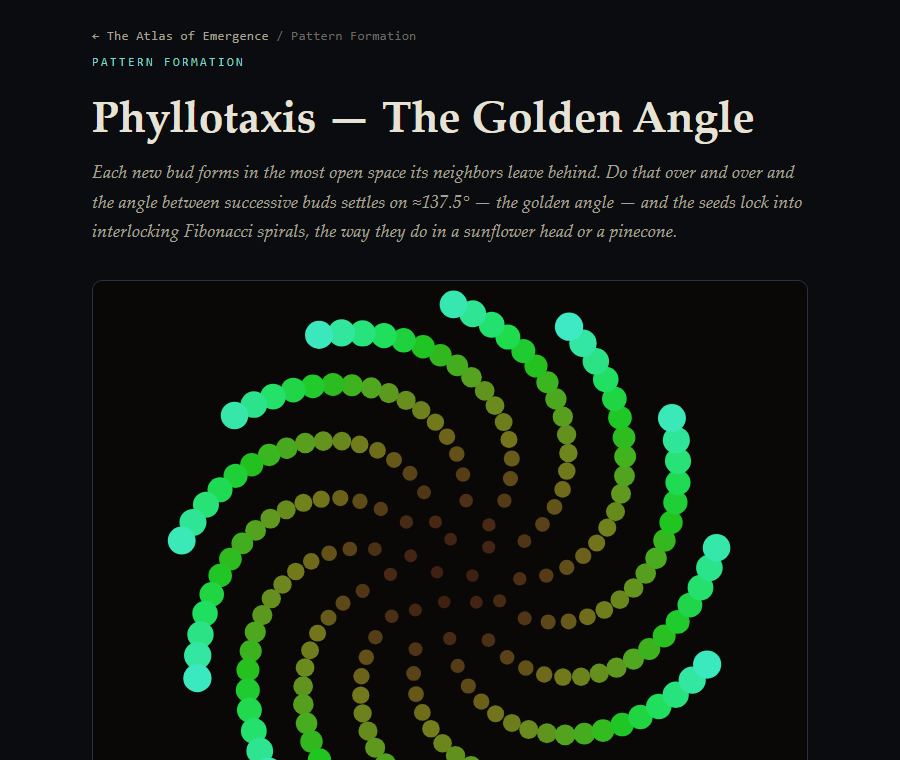
Each bud grows in the biggest gap left by the others — and the angle between them drifts, all on its own, to the golden 137.5° of a sunflower.
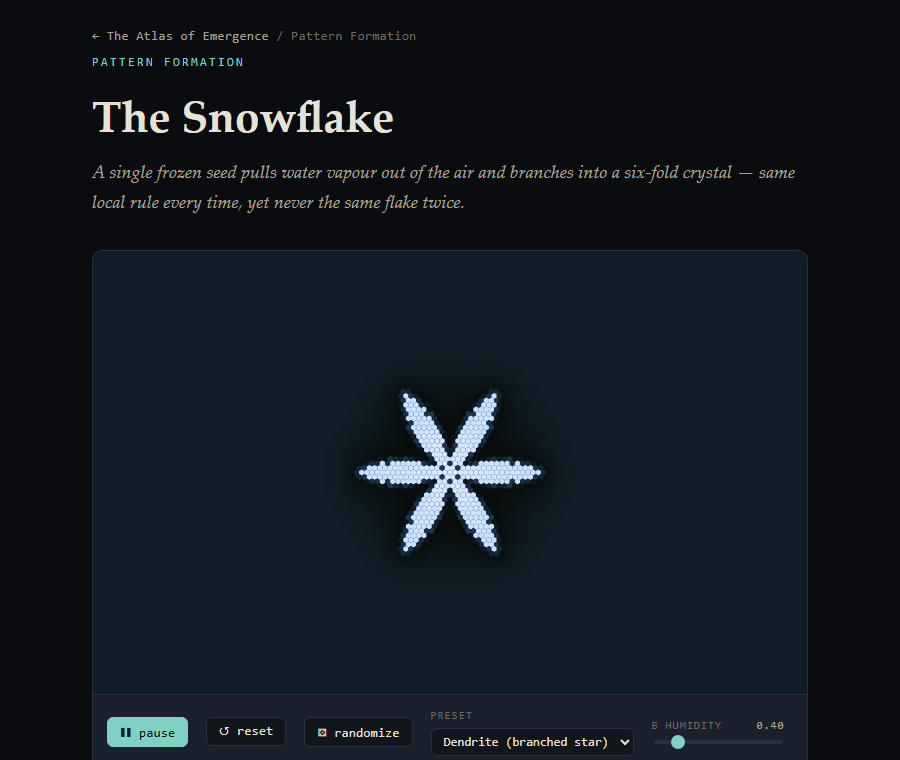
The Snowflake
One frozen seed pulls vapour from the air and branches as it grows — and because ice is hexagonal, all six arms grow alike into a crystal no other will ever match.
Criticality
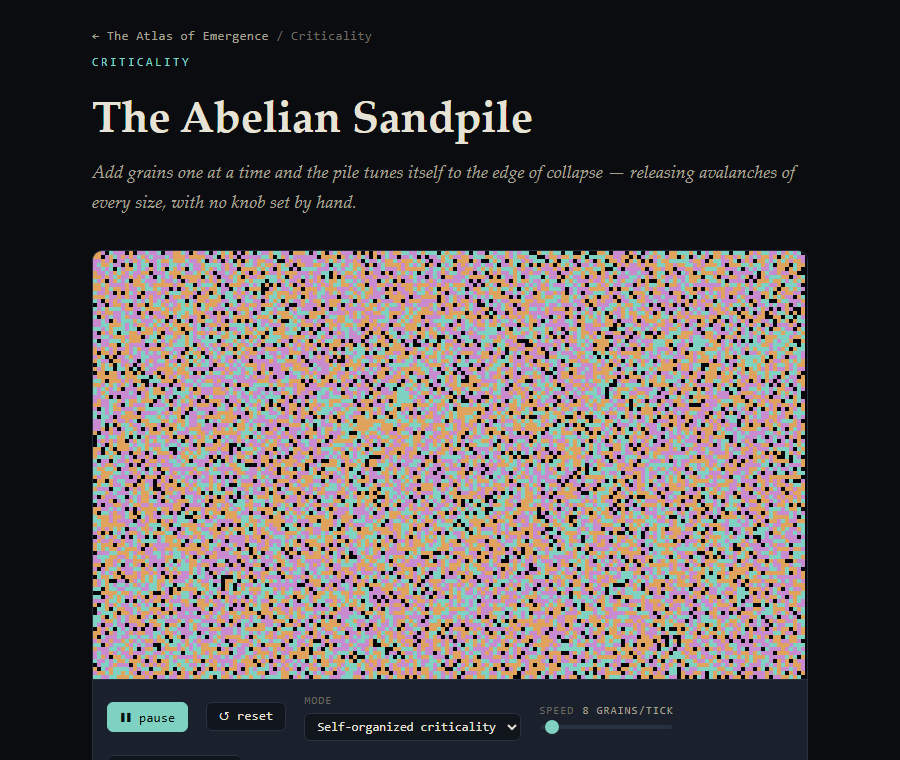
The Abelian Sandpile
Drop grains one at a time and the pile tunes itself to the edge of collapse, with avalanches of every size.
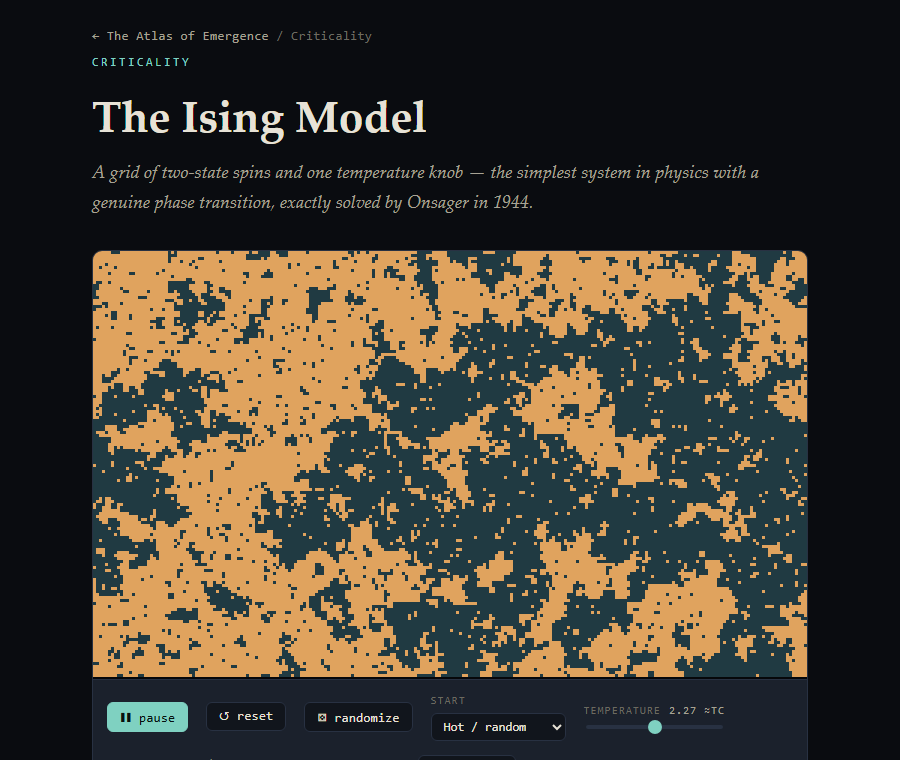
The Ising Model
Spins that merely want to match their neighbors undergo a sharp phase transition at a critical temperature.
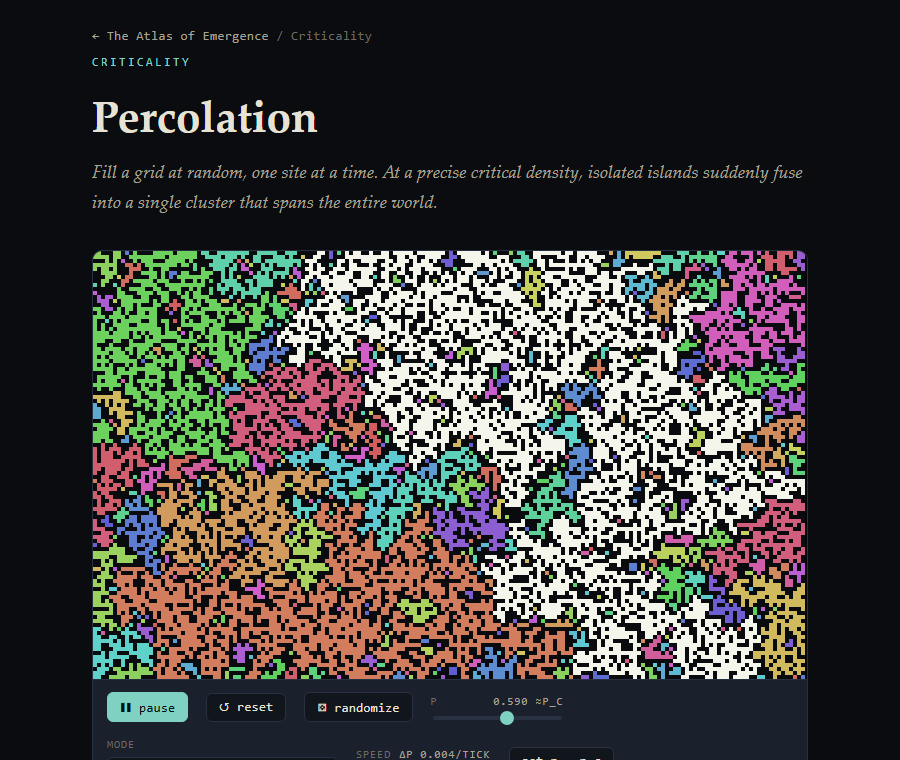
Percolation
Fill a grid at random and, at one critical density, scattered clusters suddenly merge into a path across the whole world.
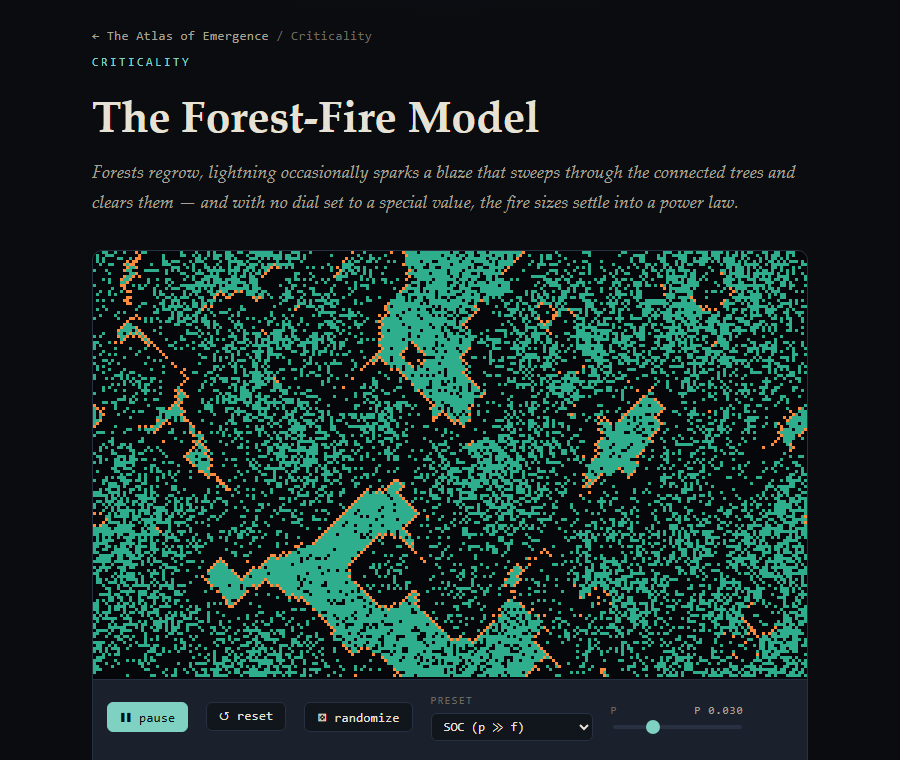
The Forest-Fire Model
Trees grow, lightning sparks, fire sweeps connected stands — and the forest tunes itself to the edge of burning.
Synchronization
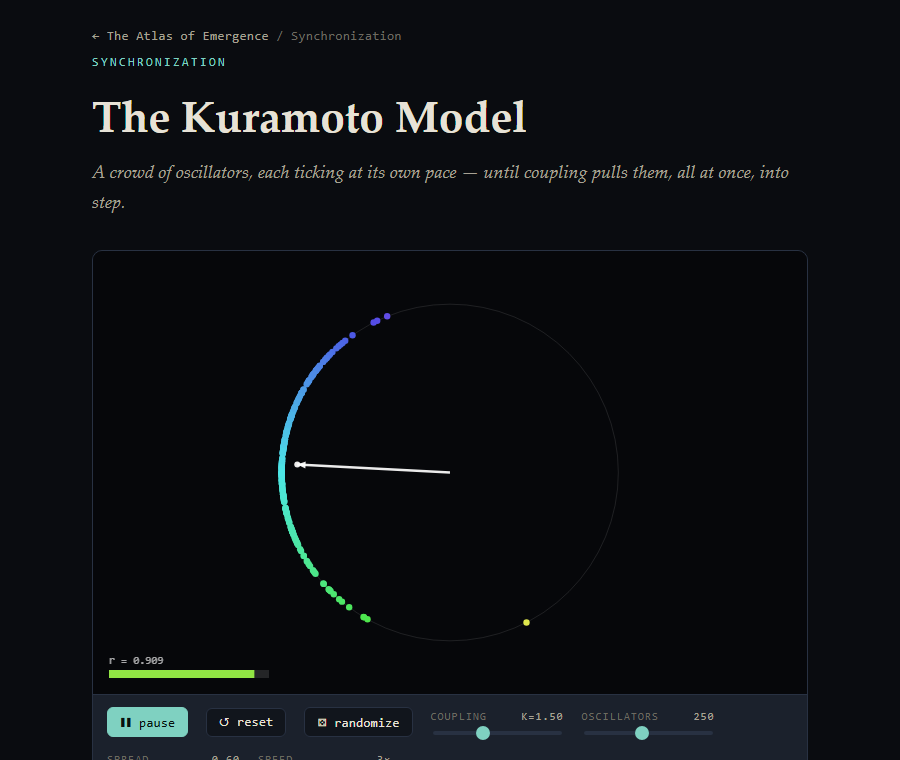
The Kuramoto Model
A crowd of oscillators, each minding only the average, spontaneously locks into step past a critical coupling.
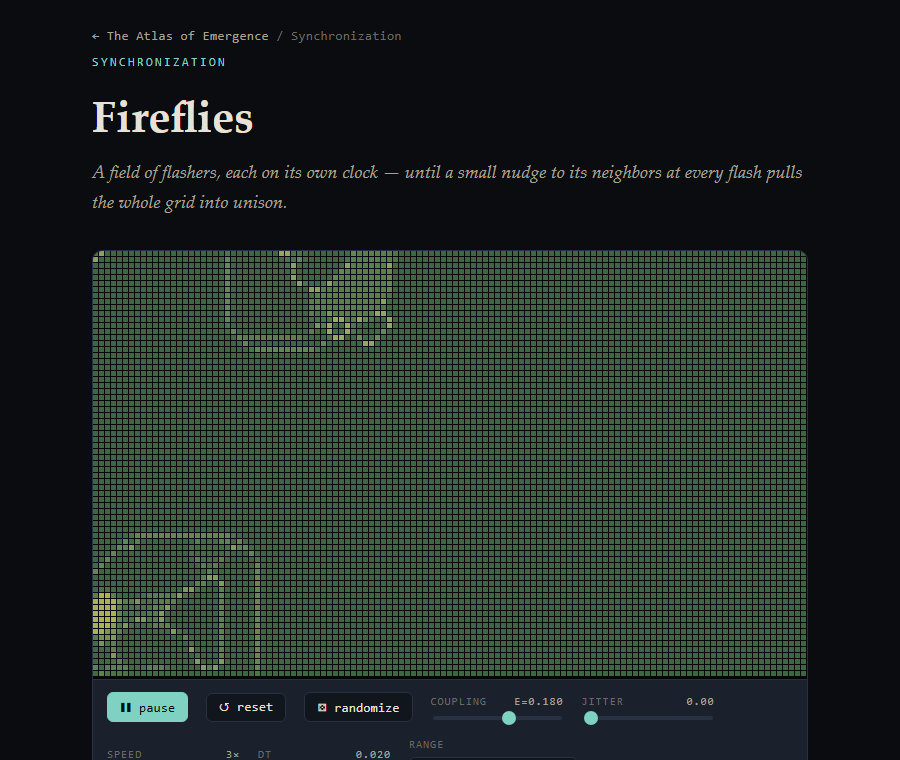
Fireflies
A field of flashers, each nudging its neighbors a little when it fires, slides from chaos into unison.
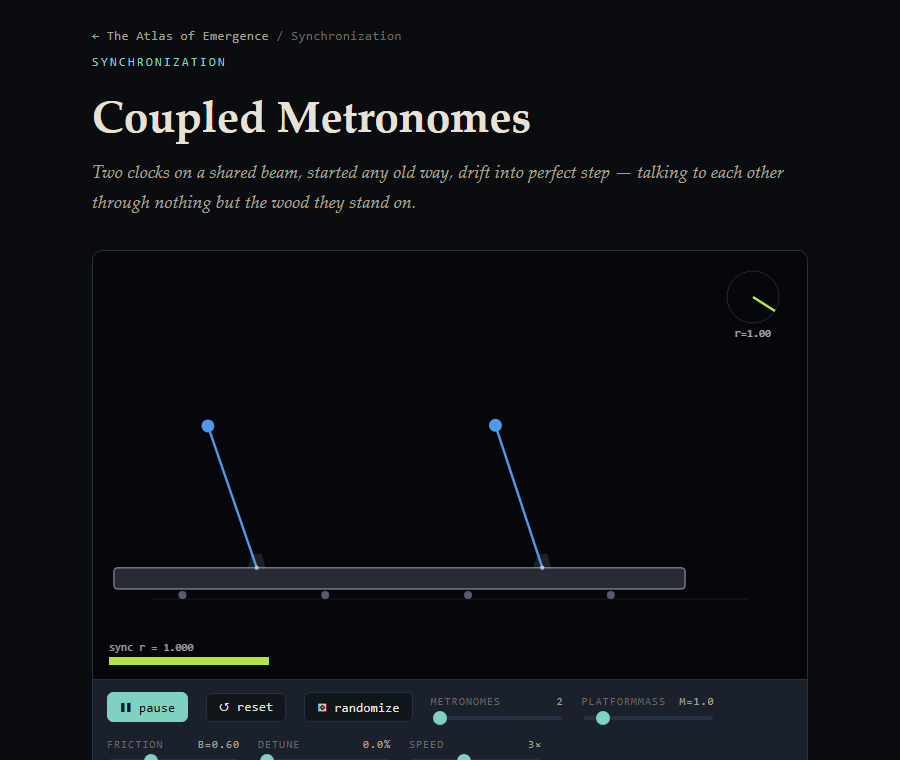
Coupled Metronomes
Metronomes started every-which-way fall into perfect step — coupled by nothing but the board they share, as Huygens saw in 1665.
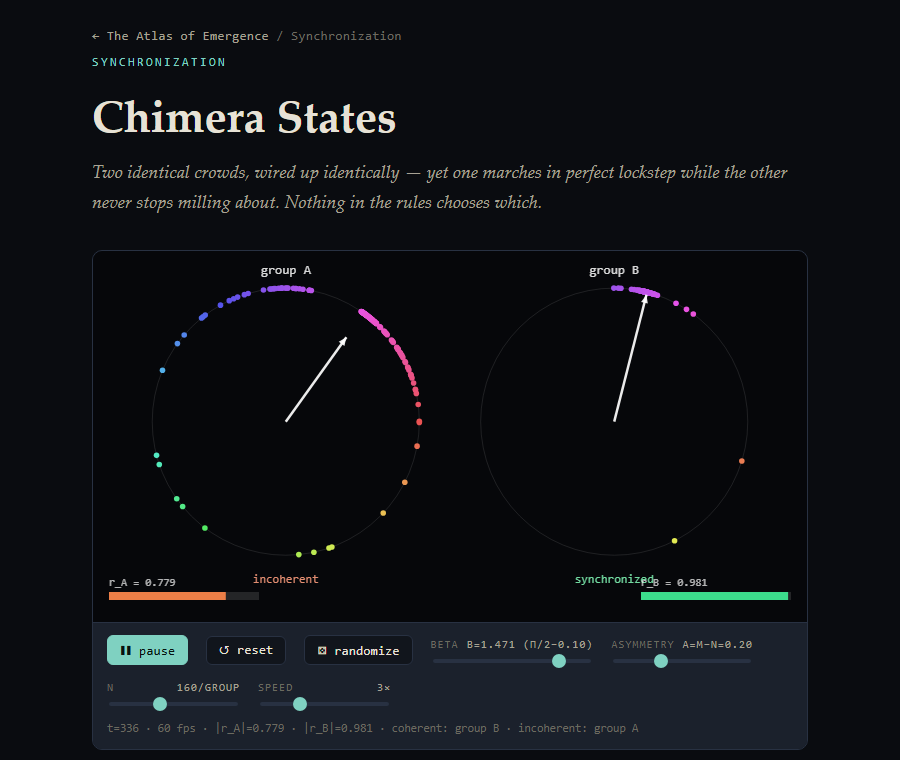
Chimera States
Two identical crowds of identical oscillators, wired up identically — yet one locks into perfect step while the other mills in permanent disorder.
Networks
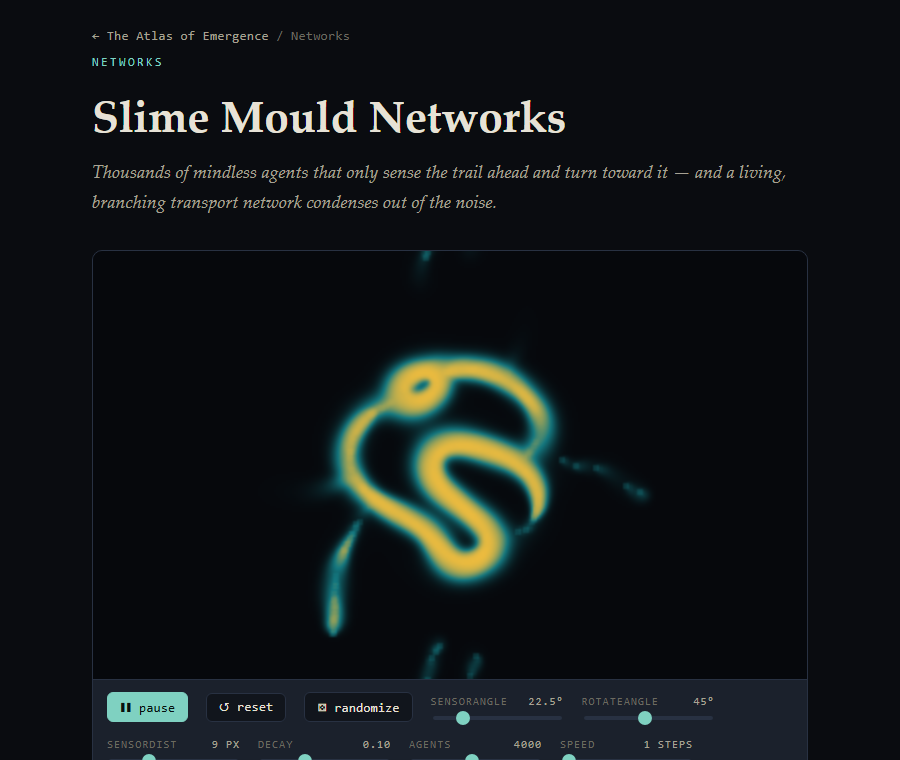
Slime Mould Networks
Brainless agents laying and following trails weave themselves into efficient transport networks.
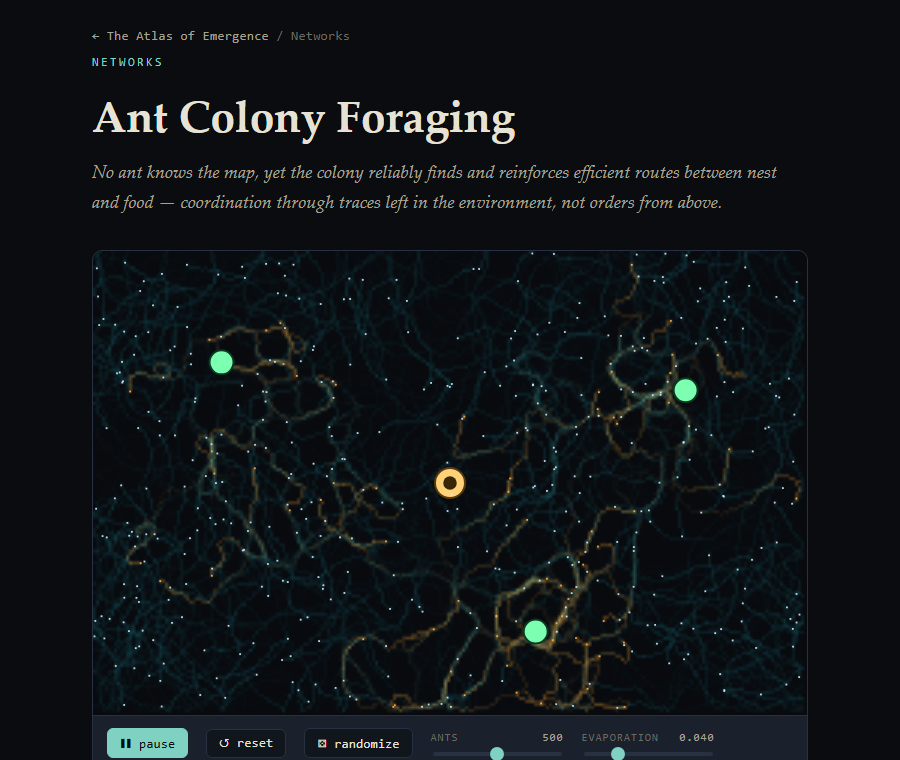
Ant Colony Foraging
Ants that only lay and follow scent, and let it evaporate, collectively wire the nest to food along efficient trails.
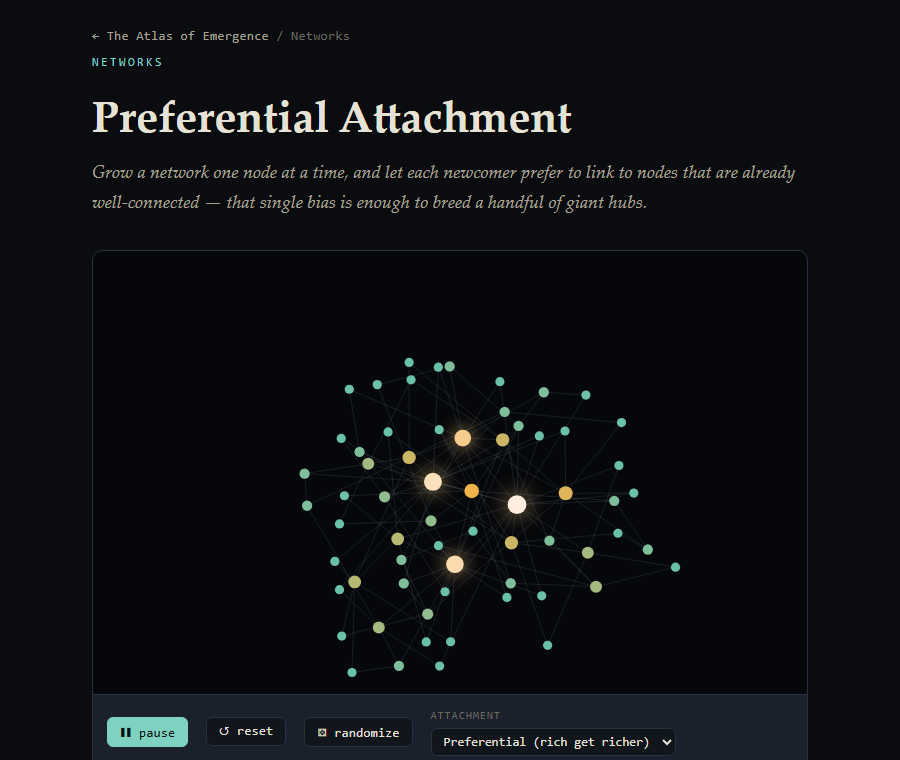
Preferential Attachment
New nodes prefer to link to already-popular ones — and a few runaway hubs grow a scale-free network from a single bias.
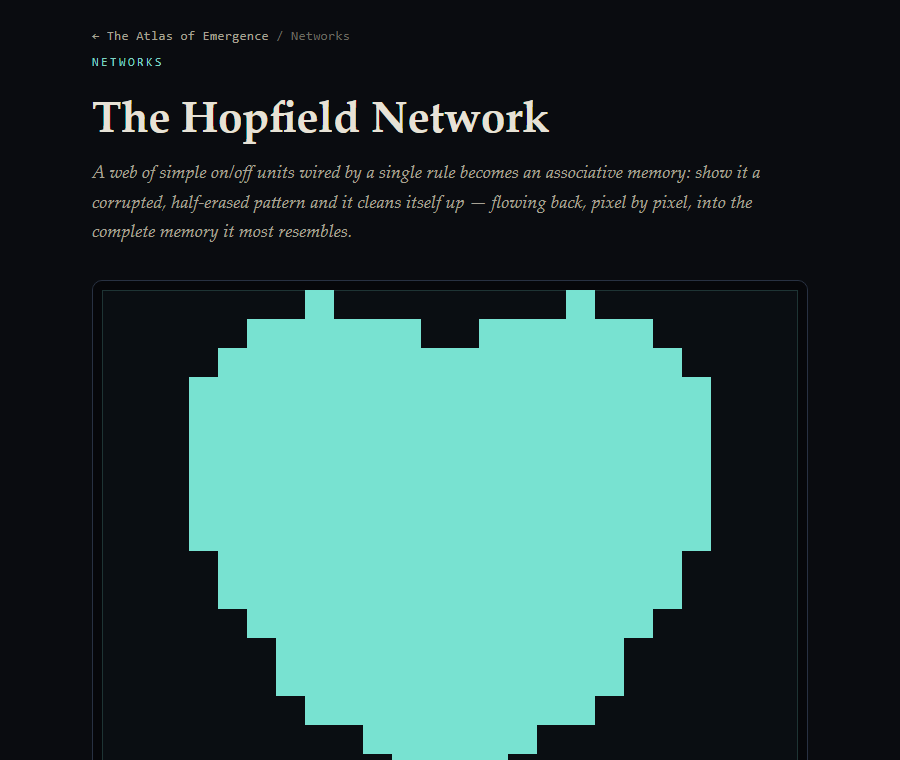
The Hopfield Network
Show a web of simple on/off units a corrupted memory and it cleans itself up — flowing downhill to the stored pattern it most resembles.
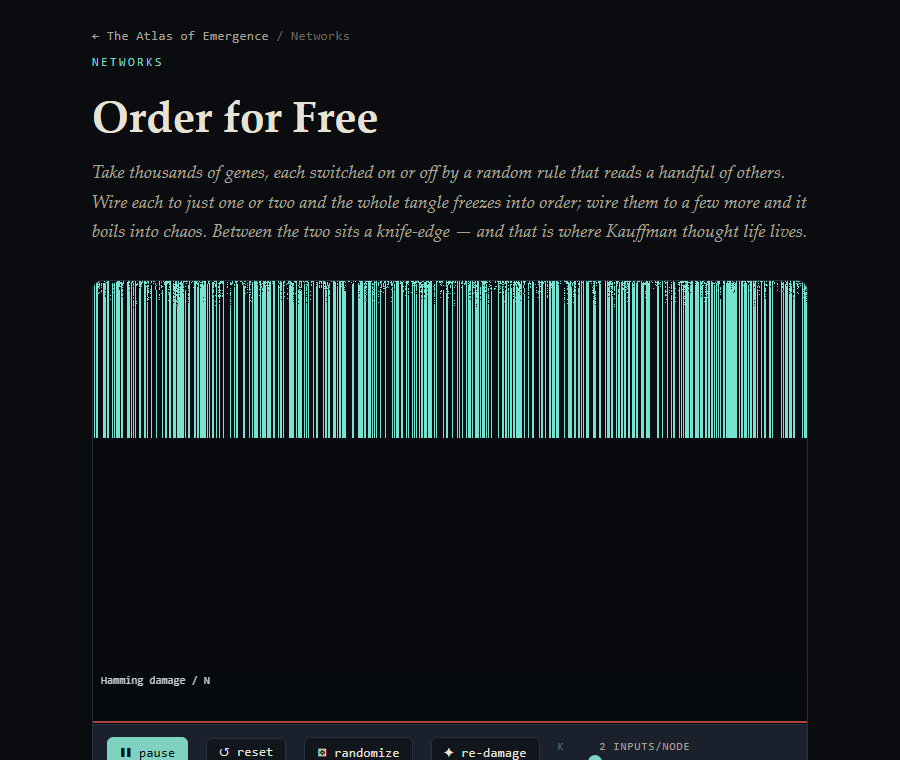
Random Boolean Networks
Wire thousands of on/off genes at random — and whether the tangle freezes into order or boils into chaos turns on a single number: how many inputs each one listens to.
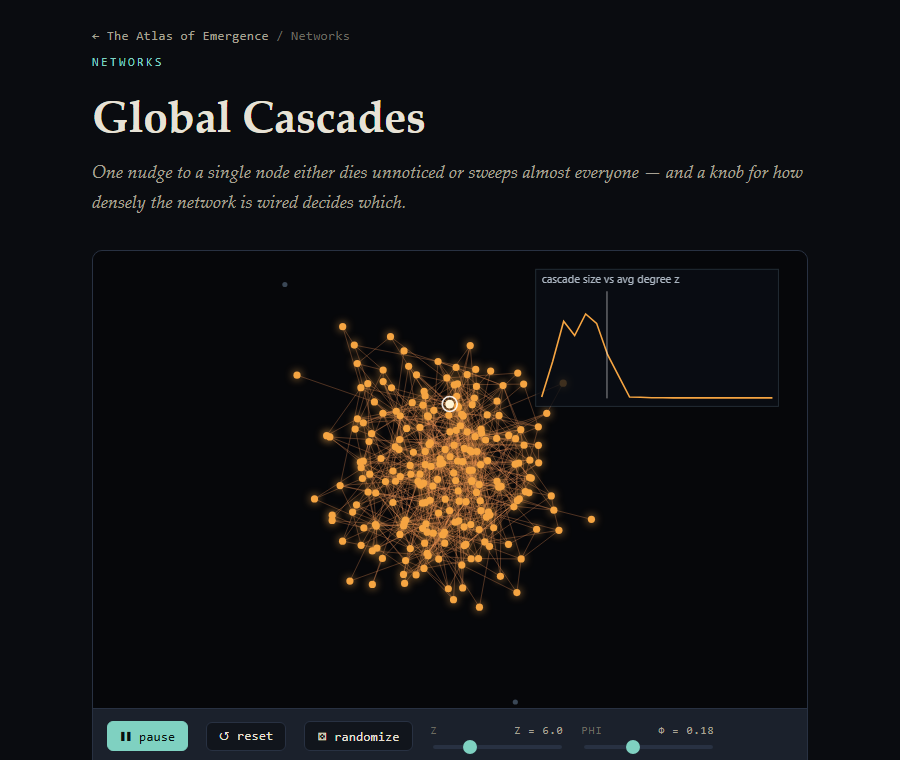
Global Cascades
One nudge to one node either dies unnoticed or sweeps the whole network — and, strangely, a more connected network can be the harder one to topple.
Social Dynamics
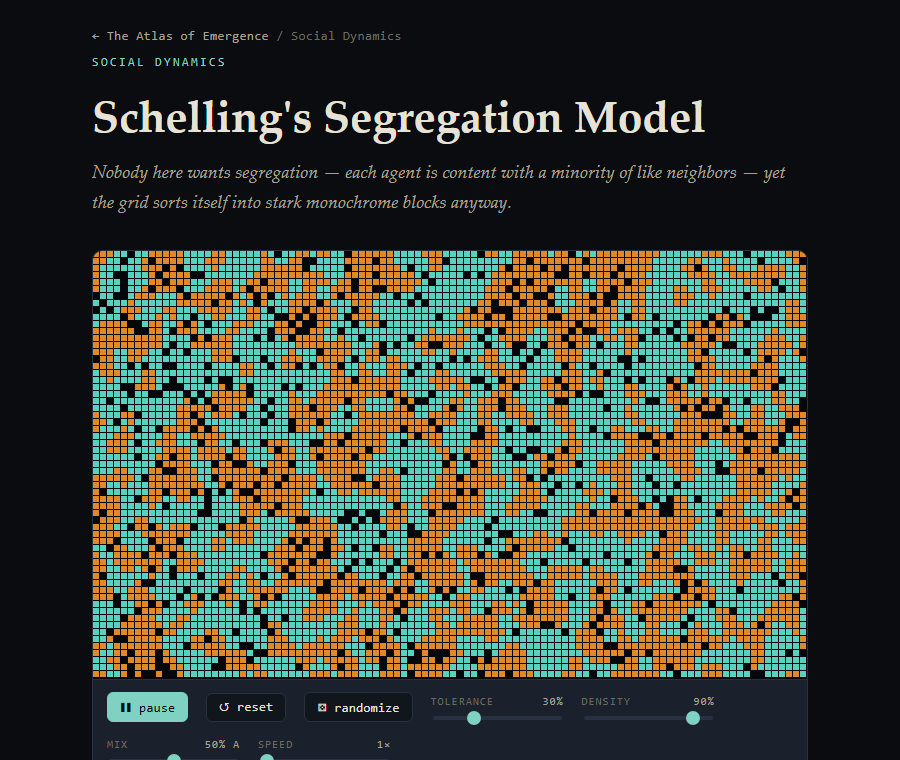
Schelling's Segregation Model
No one wants a segregated city, yet a mild preference to not be a small minority is enough to produce one.
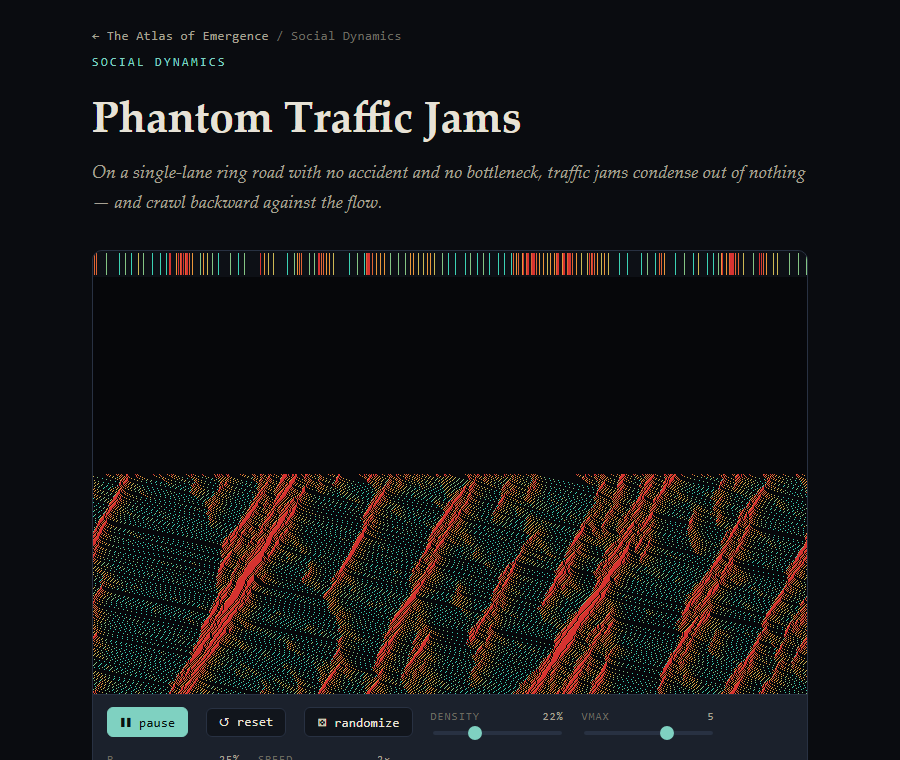
Phantom Traffic Jams
On a road with no accident and no bottleneck, dense traffic spontaneously congeals into backward-traveling jams.
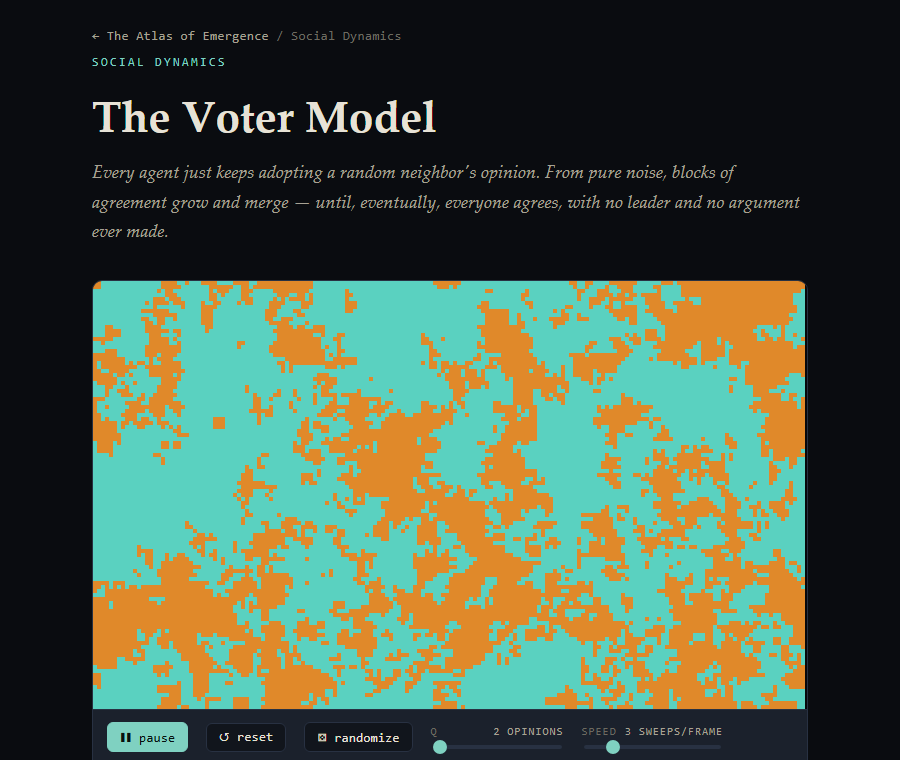
The Voter Model
Everyone just copies a random neighbor — and from pure noise, blocks of agreement grow until one opinion wins.
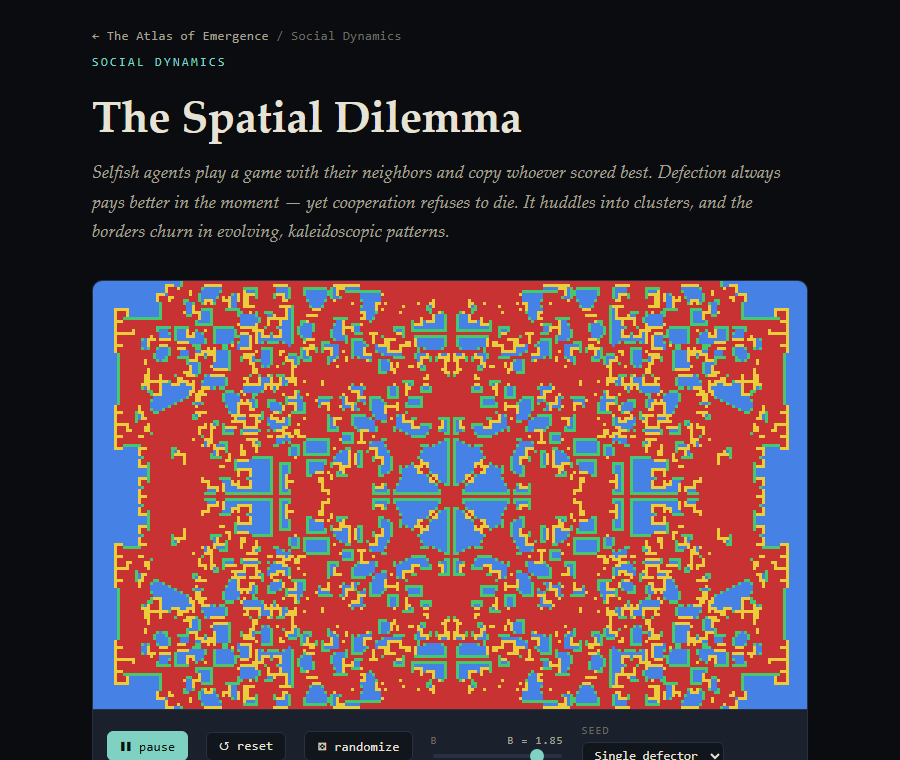
The Spatial Dilemma
Defection always pays better — yet on a grid where agents copy their most successful neighbor, cooperation huddles into clusters and refuses to die.
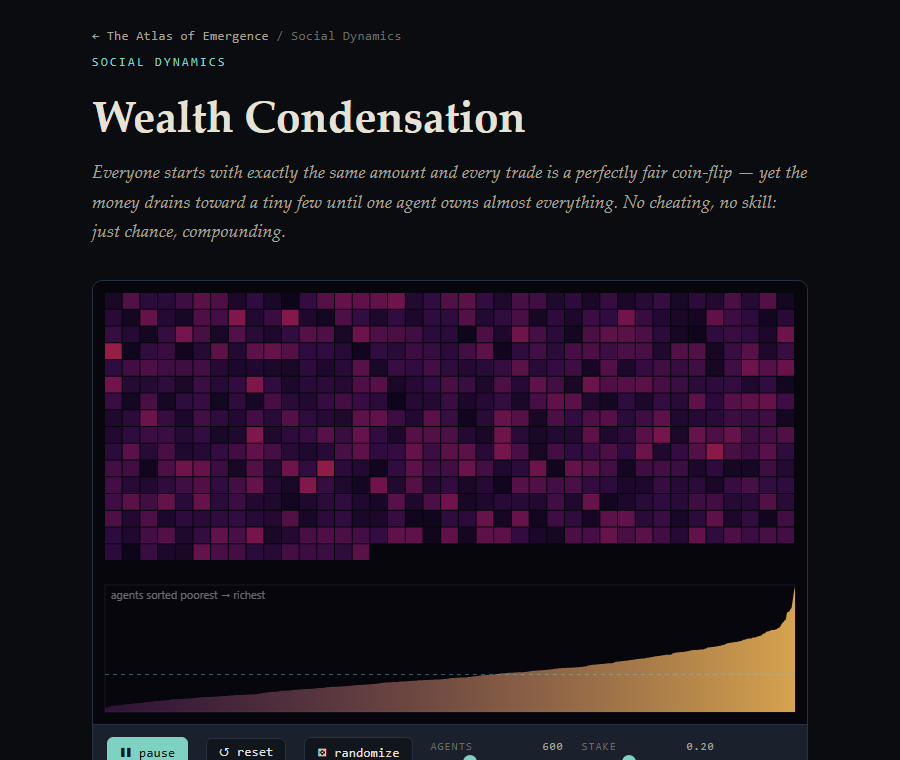
Wealth Condensation
Everyone starts equal and every trade is a fair coin flip — yet the money drains, almost surely, into the hands of a single agent.
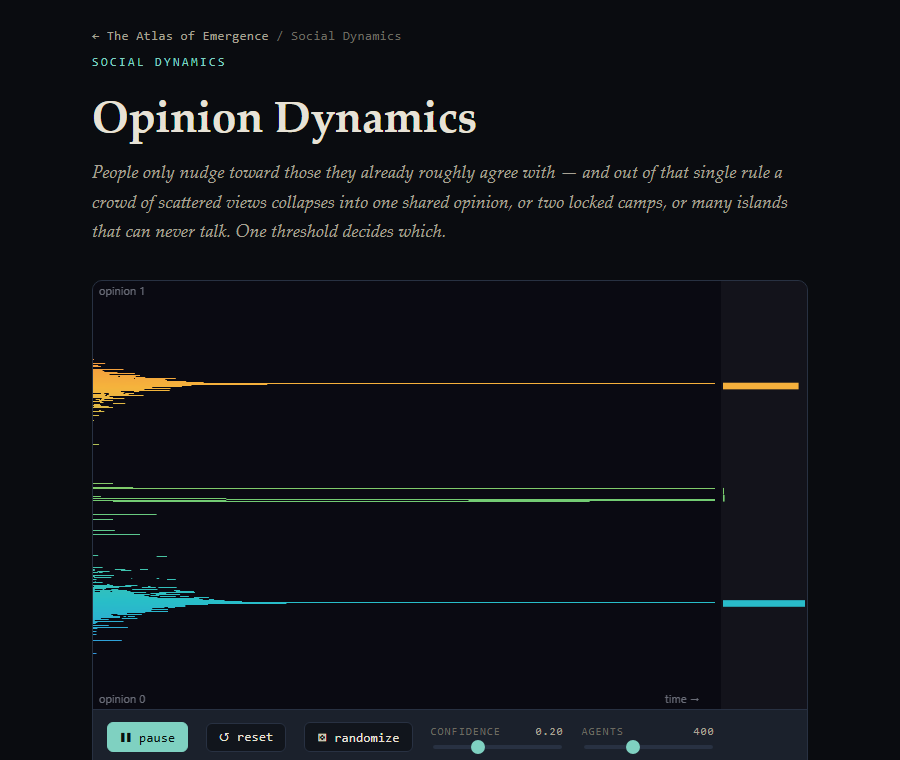
Opinion Dynamics
People only nudge toward those they already roughly agree with — and that one threshold decides whether a crowd reaches consensus, splits in two, or shatters into islands.
No phenomena match that. Clear filter
Essays
What Emergence Is
The idea this Atlas is built around — local rules, global order, and how to read the map.
The Edge of Chaos
Every simulation here has a knob. Somewhere along it sits a critical point where the system comes alive.
Themes — The Ideas That Recur
A second axis through the Atlas: pick a deep idea — phase transitions, power laws, the edge of chaos — and see everywhere it surfaces.